What is an option? It’s a reservation ticket.
If you’ve paid to reserve sneakers, a console, concert tickets, or a house, you already get the idea. A stock option is the same kind of contract — a paid right, with a deadline, on an underlying asset.
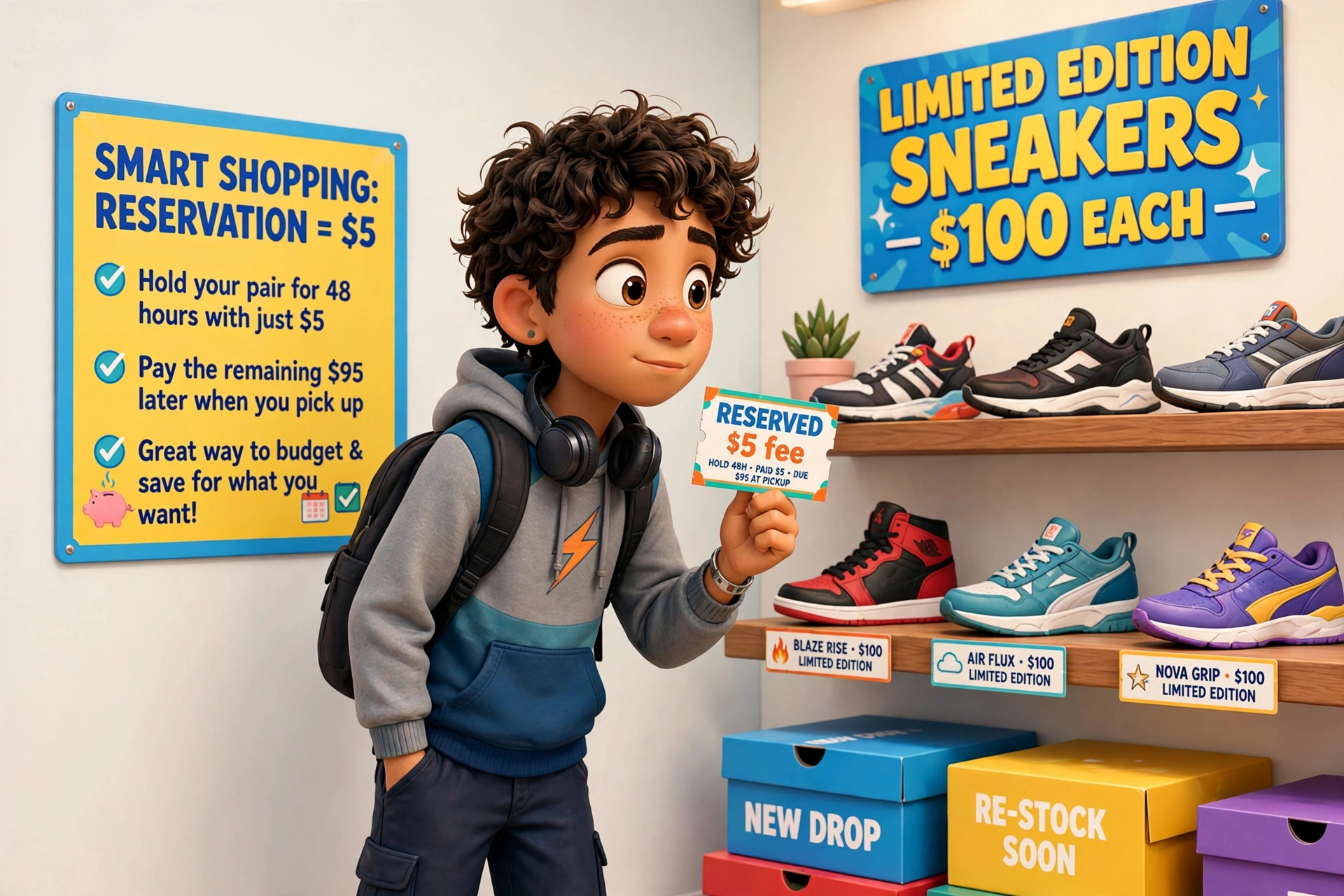
Story 1: The $100 sneakers (a Call)
Limited sneakers cost $100. You only have $5 today. You pay $5 to reserve the right to buy at $100 within 30 days.
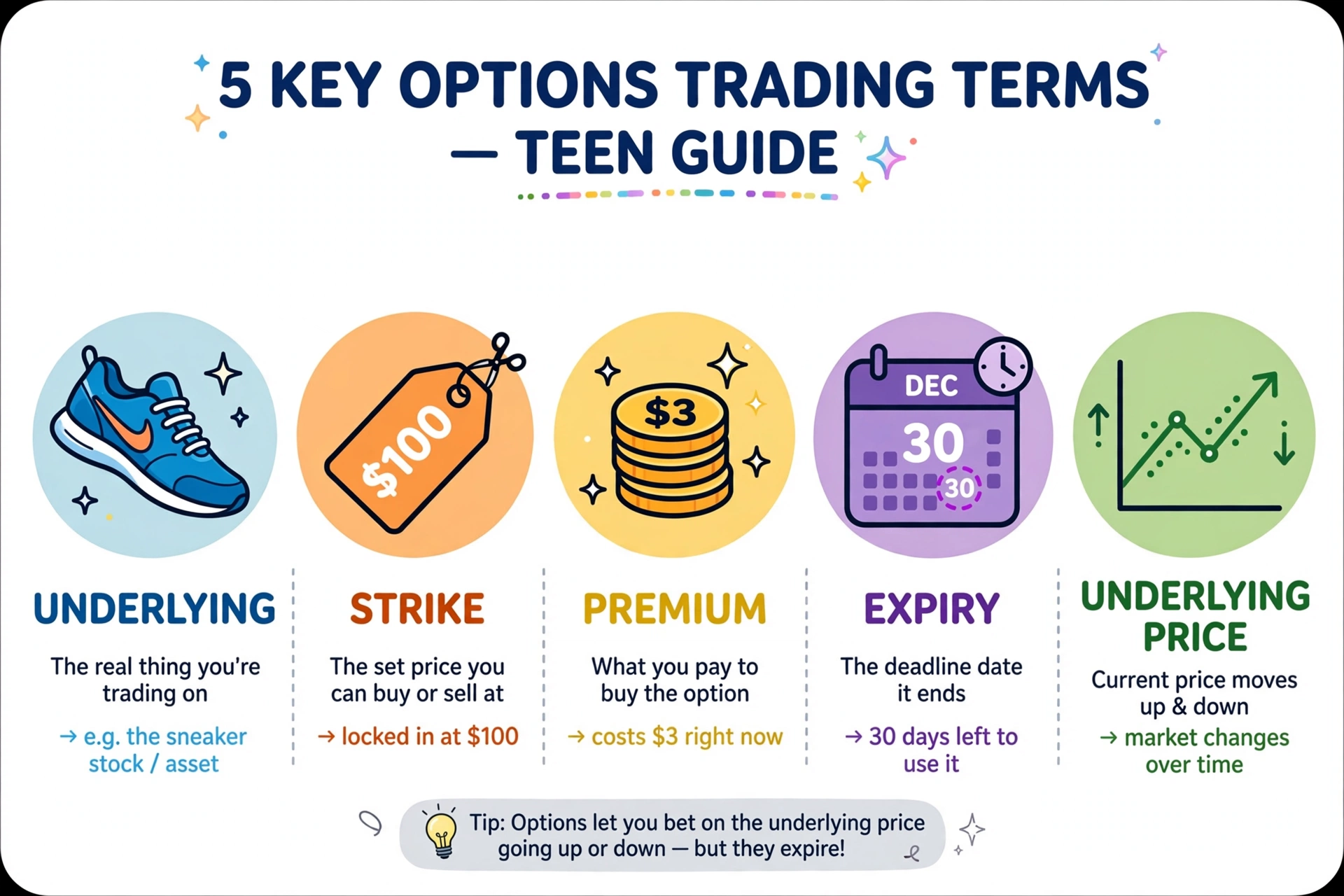
That $5 is the Premium. $100 is the Strike. 30 days is the Expiry. The sneakers are the Underlying.
- Sneakers go to $150 → you still buy at $100. Economic gain about $45 after the $5 fee ($50 intrinsic − $5 premium).
- They fall to $70 → you walk away. Loss only the $5 premium.
That contract is a Call. CALL = right to BUY.
Story 2: House — Call vs Put
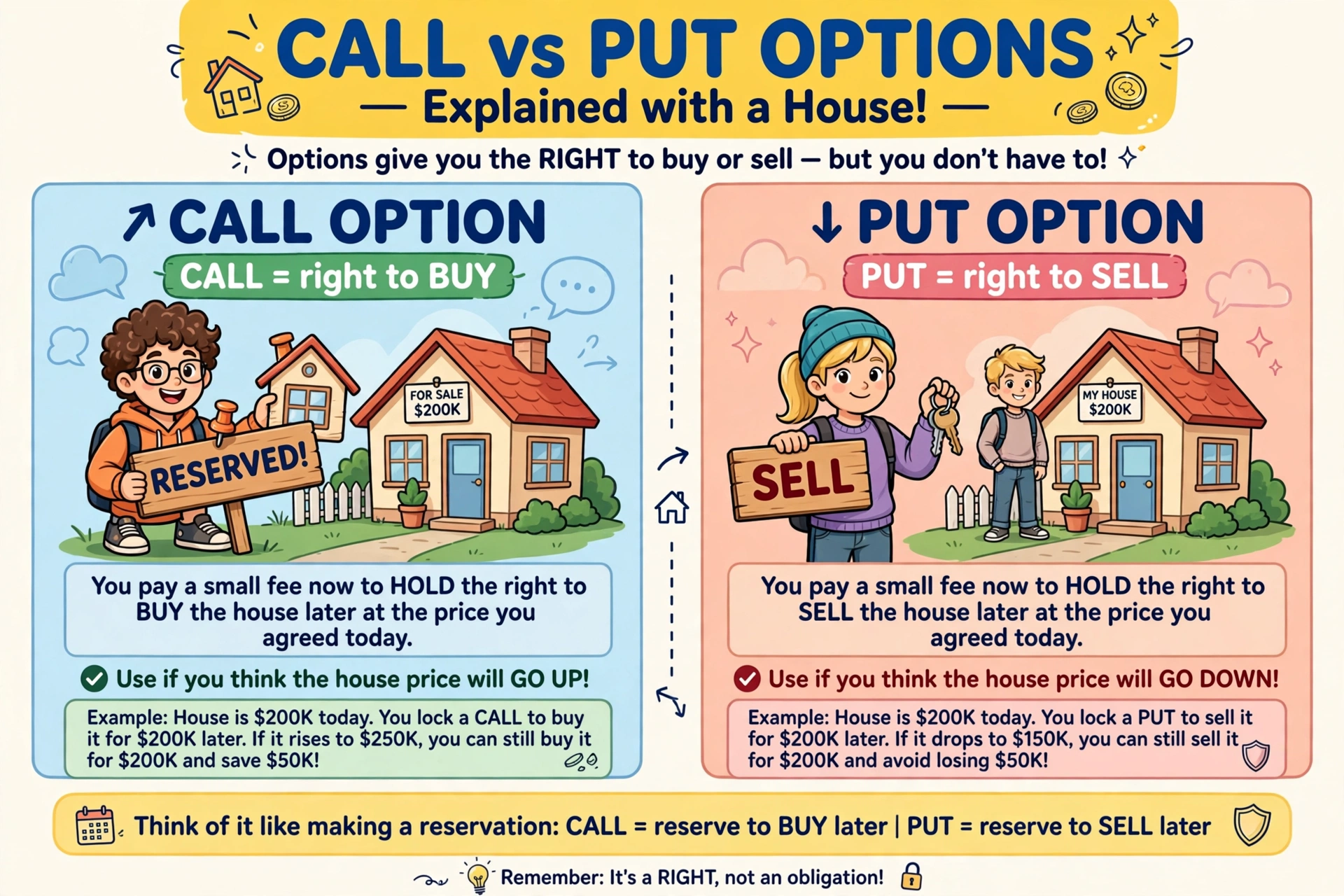
Call: you pay a fee now to lock the right to buy later at a set price — useful if you expect the price to go up.
Put: you pay a fee to lock the right to sell at a set price — useful if you expect the price to go down, or as insurance on something you already own.
Story 3: Concert tickets (time runs out)
Face value $200, show in 30 days. You pay $20 for the right to buy at $200. If resale hits $400, that right is valuable. If resale is $100, you let it expire and lose only the $20.
Expiry is the hard deadline. After expiration, an option that finishes out of the money is typically worth zero. Time is not free — every day that passes can reduce the “extra” value of the option beyond pure intrinsic value.
Five core words
- Underlying — the asset the option is written on (stock, ETF, index… or sneakers in the story).
- Strike — the agreed buy (call) or sell (put) price.
- Premium — the price of the option, quoted per share.
- Expiry / DTE — when the right ends; DTE = days to expiration.
- Call vs Put — call = right to buy; put = right to sell.
Long = you buy the option. Short = you sell (write) the option. This page focuses on long options — the side with defined risk equal to the premium.
Why everything is ×100
One standard U.S. equity option contract usually covers 100 shares. Brokers quote premiums per share, so you must multiply by 100 to get real cash.
If that option later trades at $5.00, the position is worth about $500. Your P/L is on the full ×100 amount — not the $3 or $5 alone.
Options Moneyness Guide - Example
Example Scenario: Current Price = $100 | Sample Strikes: $50, $75, $100, $125, $150 — Educational Example Only
For Call Options - Example
CALLDelta < 0.45
$125, $150
≈ 0.50
$100
Delta > 0.55
$50, $75
For Put Options - Example
PUTDelta < -0.55
$125, $150
≈ -0.50
$100
Delta > -0.45
$50, $75
How Delta Moves a Call Value - Example → Full Interactive →
Formula: Call Change = Stock Change × Delta — Drag the stock price and see the call move
⏳ Theta decay: the rent you pay for time
Every option price has extrinsic (time) value. Even if the stock stays perfectly flat, that time value melts every day. That melt is theta.
❌ 1. Against buyers
You buy 1 call: $4.00 ×100 = $400 debit, stock $100, 60 DTE.
Stock stays at $100 for 30 days. No move. Call is now $2.10 — lost $190 to time alone. You need move + speed to beat theta.
Buyer lesson Time is your cost.
✅ 2. For sellers (CSP)
You sell cash-secured put: Strike $95, you collect $1.50 ×100 = $150. Stock $100.
If stock stays ≥ $95 for 30 days, put decays to $0.40. Buy back, keep $110. Theta paid you.
Seller edge Time is your friend — but assignment risk remains.
Intrinsic vs extrinsic (time) value — visualizer
Every premium is Premium = Intrinsic + Extrinsic. Drag the stock price and watch the two parts change in real time. Intrinsic is what you’d have if you exercised now. Extrinsic is time + volatility hope — it melts to $0 at expiry.
Payoff picture (long call)
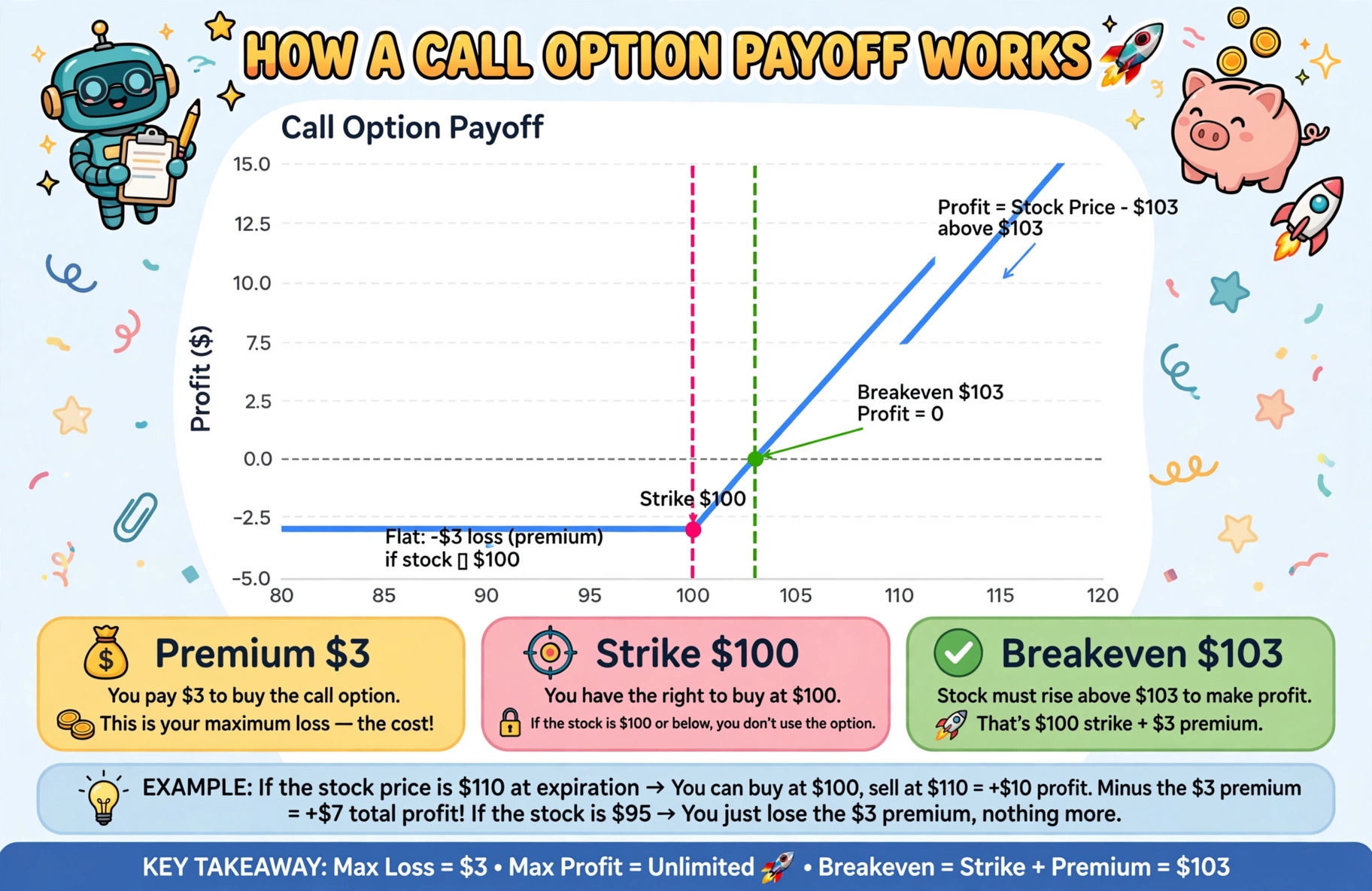
At expiration, below the strike you typically lose the premium paid. Above the strike, value rises roughly dollar-for-dollar with the stock. Rough break-even ≈ strike + premium paid.
One contract = 100 shares, so $3 ≈ $300 cash at risk.
Long put in one minute
A long put is the bearish twin of the long call: you pay a premium for the right to sell 100 shares at the strike. You profit if the stock falls enough to cover the premium. Maximum loss is still only the premium paid.
Payoff picture (long put)
Green = profit · Red = loss · Yellow dot = break-even at expiry
At expiration if stock is $80: intrinsic = $15 → profit ≈ ($15 − $2.50) × 100 = +$1,250.
If stock stays above $95: put expires worthless → loss = $250 (the “insurance premium”).
Break-even at expiration for a long put ≈ strike − premium paid (here ≈ $92.50).
How to read an options chain
An options chain is the table your broker shows for one stock or ETF: calls on one side, puts on the other, with strikes down the middle, for a chosen expiration date. Prices update during market hours; after the close you often see the last recorded quotes.
JSM Options is an educational site only. We are not affiliated with, endorsed by, or connected to any broker, exchange, or data provider. Screenshots and examples below are for learning how chains are typically organized — layouts differ by platform.
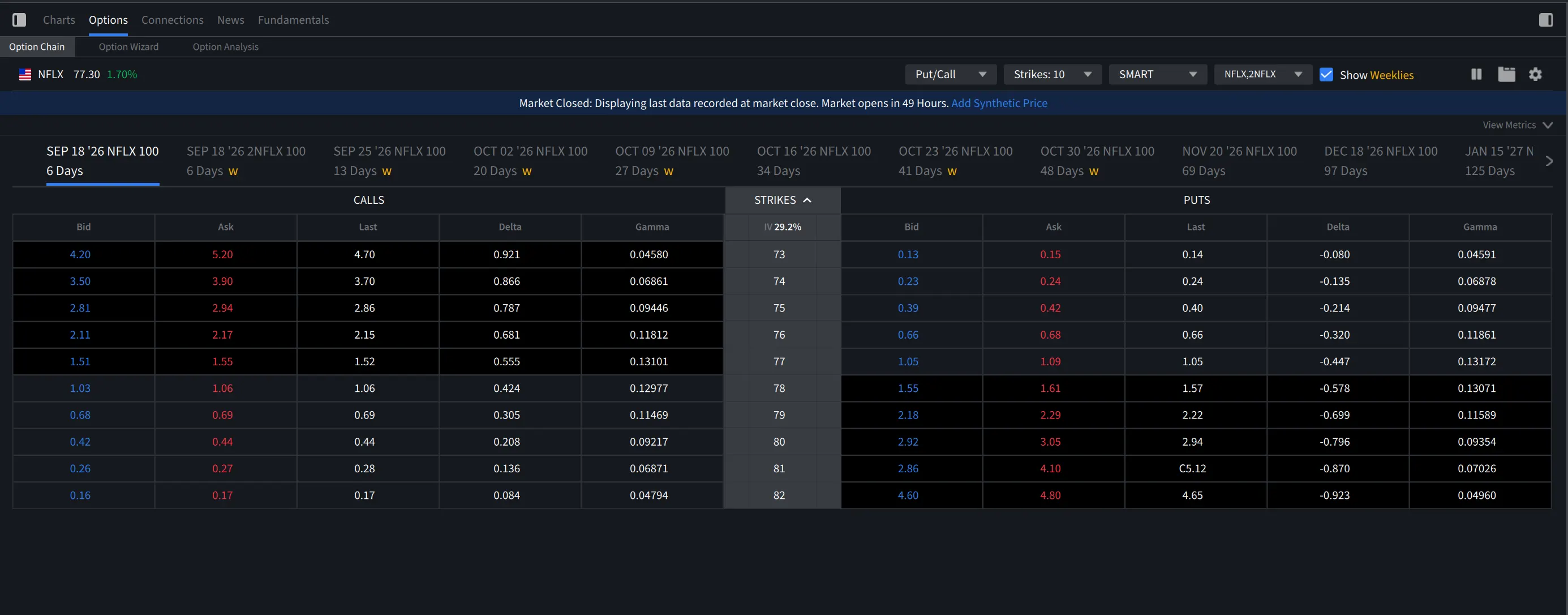
Example layout only (illustrative). Your broker’s labels, colors, and columns may differ. Not a recommendation to trade this or any symbol.
What you are looking at
- Underlying & last price — the stock/ETF the options refer to (and often today’s % change).
- Expiration tabs — each tab is a different expiry (e.g. weekly or monthly). “Days” shows approximate time left.
- Calls (usually left) — right to buy 100 shares at the strike.
- Puts (usually right) — right to sell 100 shares at the strike.
- Strike column (center) — the fixed price in the option contract.
Columns you will see most often
- Bid — highest price buyers are currently offering. If you sell an option, you often start near the bid.
- Ask — lowest price sellers are asking. If you buy an option, you often pay near the ask.
- Last — last trade price (can be stale if the option is quiet).
- Delta — rough sensitivity to a $1 move in the stock (calls positive, puts negative). Beginners: treat it as “how stock-like is this option?”
- Gamma — how fast delta can change. More relevant as you go deeper; safe to note and move on at first.
- IV (implied volatility) — often shown for the expiration or per strike. Higher IV → options tend to be more expensive, all else equal.
Contract size (the ×100 reminder)
Listed equity options usually control 100 shares per contract. A put with ask $1.09 costs about $109 to buy one contract (before commissions), not $1.09. Always multiply premium by 100 when estimating cash.
How orders are typically placed (general)
Steps are similar across brokers; exact buttons and names vary. This is a generic outline, not instructions for any specific firm:
- Choose the underlying (stock or ETF) and open its options chain.
- Pick an expiration (how much time you want).
- Pick call or put and a strike.
- Action: Buy to open (you are long) or Sell to open (you are short — higher risk if naked).
- Quantity in contracts (1 contract ≈ 100 shares of exposure).
- Order type: while learning, prefer a limit order (you set the max price to pay or min price to receive) over a market order.
- Review estimated debit/credit, fees, and buying power impact → submit only if you understand the max loss.
Connect the chain to this site
After you understand a quote, you can copy the strike and a realistic premium (e.g. mid) into the Strategy Builder and see payoff and educational Greeks. The Builder is a simulator — not live brokerage data and not an order ticket.
What “assignment” means (quick)
If you sell (short) an option, the buyer may exercise. Then you can be assigned: forced to buy or sell the shares at the strike. That is why short calls without owning the shares (naked calls) can be very risky.
This Basics page stays on the long side — you own the right. Selling options comes later, with clearer rules and risk limits (for example, a covered call against shares you already own).
Short answers to the questions most people ask first.
Is an option the same as owning the stock?
No. A long call gives exposure that can behave a bit like stock if it is deep in the money, but you do not receive dividends the same way, rights expire, and small moves plus time decay can still produce a loss.
Can I lose more than I paid for a long call or long put?
On the option itself, no — maximum loss is the premium (plus fees). That is why many beginners start with long options: the worst case is known upfront.
Why did my call drop when the stock barely moved?
You likely paid some extrinsic (time) value. Each day that value can shrink (time decay), and implied volatility can fall too. A small favorable stock move may not be enough to offset both. The stock has to move enough, and often soon enough.
What is the difference between intrinsic and extrinsic value?
Intrinsic is the value if exercised right now (for a call: stock minus strike, if positive). Extrinsic (time value) is the rest of the premium — time left and expected movement. At expiration, extrinsic goes to zero; only intrinsic remains.
Do I have to wait until expiration?
No. You can sell the option in the market any time before expiration (when the market is open and there is a buyer). Many people close early to lock a gain or cut a loss.
Is this a way to get rich quickly?
No. Options amplify outcomes in both directions. Sustainable progress looks like small size, one idea at a time, and learning from each trade — not all-in bets.
Next: real-number fundamentals
Long call, long put, and covered call with full examples, payoff tables, and Greeks in plain English.
Basics quiz
Four questions from this page — reservation ticket, call vs put, premium × 100, and assignment.