Vertical spreads & the iron condor
Buy one option, sell another — cut cost or define risk. This page walks through a bull call spread, a bear put spread, and the iron condor with payoff pictures and Builder links. Defined risk still means you can lose the full max loss — just not an undefined amount.
Why spreads?
A naked long call is simple but you pay full premium. A naked short call can have large risk. A vertical spread pairs a buy and a sell in the same expiry so max loss (and often max gain) are capped.
Bull call spread — the cheaper way to be bullish
This is usually the second strategy traders learn right after the long call. Why? A long call teaches you how brutal time decay (theta) can be. A bull call spread fixes part of that problem by selling a further out-of-the-money call against your long call.
You still get leverage, but you pay less upfront and you worry less about theta. The tradeoff: your upside is capped at the short strike.
How it's built
- Buy 1 call — closer to the money (lower strike)
- Sell 1 call — further out of the money (higher strike)
- Both are calls, same expiration, same underlying
- Enter as one trade. You can leg in separately but that adds risk — you could get stuck with one side moving against you.
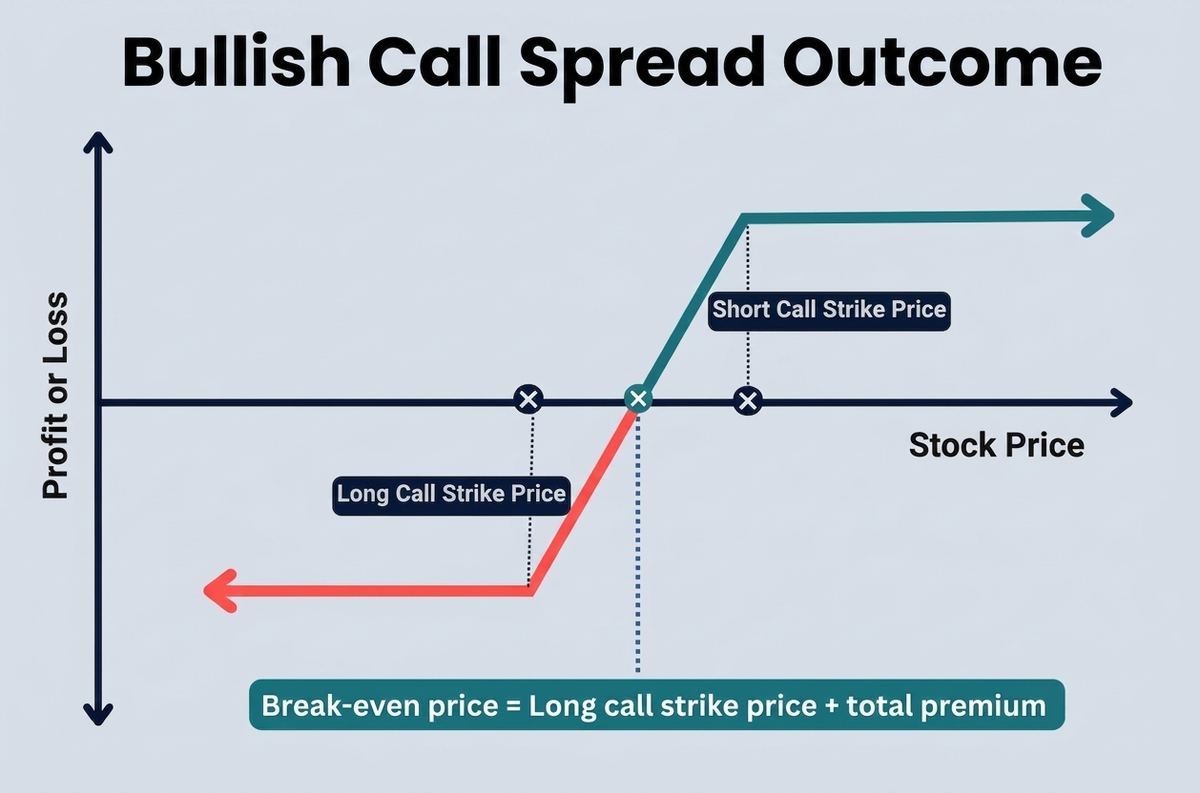
Payoff — where you win, lose, and break even
The short call is further OTM. It gives you credit that offsets your long call cost and reduces theta, but it also caps upside.
| Zone | Formula | Example 100/110 |
|---|---|---|
| Max Profit | Spread Width - Net Debit | 10 - 4 = $6 ($600). Hit when stock ≥ $110. Above $110, every $ you gain on long call you lose on short call. |
| Max Loss | Net Debit Paid | $4 ($400). Happens if stock ≤ $100 at expiry — both calls expire worthless. |
| Breakeven | Long Strike + Net Debit | 100 + 4 = $104. Stock must close above $104 to profit. At exactly $104, flat. Watch for exercise/assignment risk at breakeven. |
Real example: XLF (Financial ETF)
We think XLF goes up moderately in next 45 days. XLF trading $47.82, target $51. Broad ETF, decent bid/ask, many strikes.
- XLF Price: $47.82
- Expiry: 45 days
- Buy 48 Call @ $1.69
- Sell 51 Call @ $0.38
- Net Debit: $1.31 ($131) — also max loss
- Breakeven: $48 + $1.31 = $49.31
- Max Profit: $3.00 width - $1.31 = $1.69 ($169) if XLF ≥ $51
| Outcome | What happens |
|---|---|
| Positive — XLF to $53 at expiry | Both calls ITM with 100% intrinsic. Long 48 call worth $5.00 ($53-$48), short 51 call worth $2.00 ($53-$51). Spread value = $3.00. Profit = $3.00 - $1.31 = $1.69 ($169). Note: short call likely assigned before expiry when deep ITM near expiry — that's okay, you exercise long call to cover. |
| Negative — XLF to $44 | Both calls OTM → $0. Spread value $0. You lose $1.31 ($131). This trade actually hit ~80% max profit mid-way — should have closed early. Time is risk. Don't be greedy. |
3 major risks (plus theta)
- 1. Early assignment risk: Short call can be assigned when ITM, risk rises near expiry. Fix: just exercise your long call — offsets short stock, closes position. Usually happens when short call has no extrinsic value left, meaning you're at max profit anyway.
- 2. IV Crush: Long options like high IV. If IV drops sharply after you enter (common after earnings, Fed meetings, jobs reports), both legs lose value, but long call loses more. Spread shrinks, you can lose even if direction right.
- 3. Liquidity risk: Thin stocks/ETFs = wide bid/ask spreads, low open interest, low volume. Hard to get filled at decent price, especially when volatility jumps.
- 4. Time decay — less bad than long call: You're net long premium, so theta works slightly against you. Stock must move quick enough. But decay is less severe than single long call because short call loses value in your favor. Long call decays even if stock flat; short call helps offset. Far OTM long calls decay fastest early.
Implied Volatility — when to use it
Bull call spread is net debit, benefits from rising IV. If IV rises after entry, both legs gain, long usually gains more. If IV drops, both lose, long takes bigger hit. Spread shrinks.
How to pick strikes — beginner rules
You can tailor spread to how bullish you are:
| Outlook | Example (Stock $500) | Tradeoff |
|---|---|---|
| Slightly bullish | Buy $500 call, sell $503 call ($3 width) | Low cost, lower max profit, higher probability max profit |
| Moderately bullish | Buy $500 call, sell $510 call ($10 width) | Balanced cost and reward — most beginners start here |
| Aggressively bullish | Buy $500 call, sell $520 call ($20 width) | High cost, big profit potential, lower prob success |
- Narrow spread: cheaper, lower max profit, higher chance of hitting max.
- Wide spread: more expensive, higher max profit, lower chance.
- Don't go too narrow like 100/101 for $0.40 — high prob but tiny payoff, commissions eat it.
How to pick expiration
You're net long options, time not on your side. Theta eats long option daily.
- 1-2 months until expiration is great entry for vertical spreads. Longer than that, you overpay for long option.
- Gives time to adjust/exit if wrong. With 4 DTE, no time to roll.
- Take profit early: If you lock 80% of max profit with ~2 weeks left, close it. Risk/reward not worth holding. Bears make money, bulls make money, but pigs get slaughtered.
Delta selection — beginner guide
Delta = how much option price moves per $1 stock move, and rough probability ITM.
| Leg | Target Delta | Why |
|---|---|---|
| Long Call | 0.50 - 0.60 | Higher probability, decent stock sensitivity |
| Short Call | 0.20 - 0.35 | Less likely to finish ITM, caps upside but cheaper |
| Delta Spread | 0.30 - 0.40 | Wide enough to profit, narrow enough realistic |
How to manage — not set and forget
- Take profits before expiry: If at/near max profit, close early. If you hold, long call ITM may be auto-exercised → you buy 100 shares at strike. If short call OTM, you're left long stock you didn't want. If both ITM, exercised + assigned = extra fees vs just closing spread.
- Roll short leg up to higher strike to increase max profit (if stock strong).
- Roll long leg closer to money to regain delta if stock pulls back.
- Roll both legs up/down together to reposition (4-way vertical).
- Roll expiration out later if need more time — roll both legs same time as 4-way. Don't roll one leg only, you get exposed.
Greeks — what matters for bull call spread
| Greek | Effect | Beginner meaning |
|---|---|---|
| Delta | Positive | Long call adds positive delta, short offsets some. Net delta rises as stock rises. You make money when stock up. |
| Gamma | Slightly Positive | Long adds gamma, short subtracts. Net gamma lower than single long call — less sensitive to sharp moves, smoother P/L. |
| Theta | Slightly Negative | Long loses value daily, short gains. Not fully offset — time decay slightly against you. |
| Vega | Neutral to Slightly Positive | Long benefits from IV rise, short hurt. Net vega low — volatility changes minimal impact. Best in low IV rising to high. |
| Rho | Neutral | Long benefits from rising rates, short hurt. Mostly offset. Minimal, especially short-dated. |
Bear put spread
A bear put spread (also called a put debit spread) is how many traders express a moderately bearish view with defined risk. You buy a put at a higher strike and sell a put at a lower strike, same expiration. You pay a net debit.
In plain English: you want the stock to fall, but you sell a cheaper lower-strike put to reduce what you pay. That also caps how much you can make — the short put limits the upside of the long put.
- Max loss = net debit paid (×100 per spread)
- Max profit ≈ (strike width − net debit) × 100, if the stock is at or below the short put at expiry
- Break-even ≈ long put strike − net premium paid
- You are bearish-to-neutral below the long strike; a big rally hurts (you can lose the debit)
Width = $10. Max loss = $400 per spread. Max profit ≈ ($10 − $4) × 100 = $600.
Break-even ≈ $100 − $4 = $96. Below $90 at expiry you still only make the max $600 — the short put caps further gains.
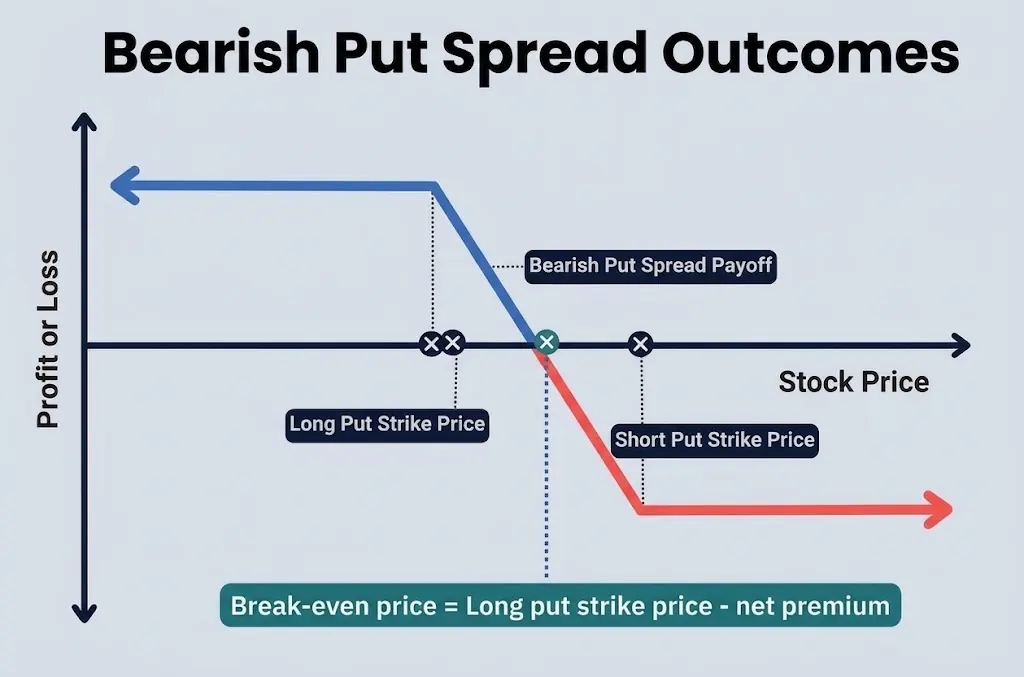
Blue = profit region · Red = loss region. The green X marks break-even (long put strike − net premium). The short put strike is where max profit flattens.
Why beginners study this
- Cheaper than buying a put alone (short put helps pay for the long put)
- Risk is known on day one (the debit)
- Same “vertical” idea as the bull call spread, flipped for a down move
Iron condor
An iron condor combines a bull put spread (below the market) and a bear call spread (above the market), same expiration. You collect a net credit. You want the stock to stay in a range between the two short strikes so both short options expire worthless (or are cheap to buy back).
In plain English: you sell “wings” of insurance on both sides and buy further OTM options so a crash or melt-up cannot produce unlimited loss. Profit is largest if price stays quiet in the middle.
- Max profit ≈ net credit received if price finishes between the short put and short call
- Max loss ≈ width of the wing that is tested − credit (still defined)
- Break-evens ≈ short put − credit (lower) and short call + credit (upper)
- Best intuition: neutral / range-bound; hard trends and IV spikes can push price into a wing
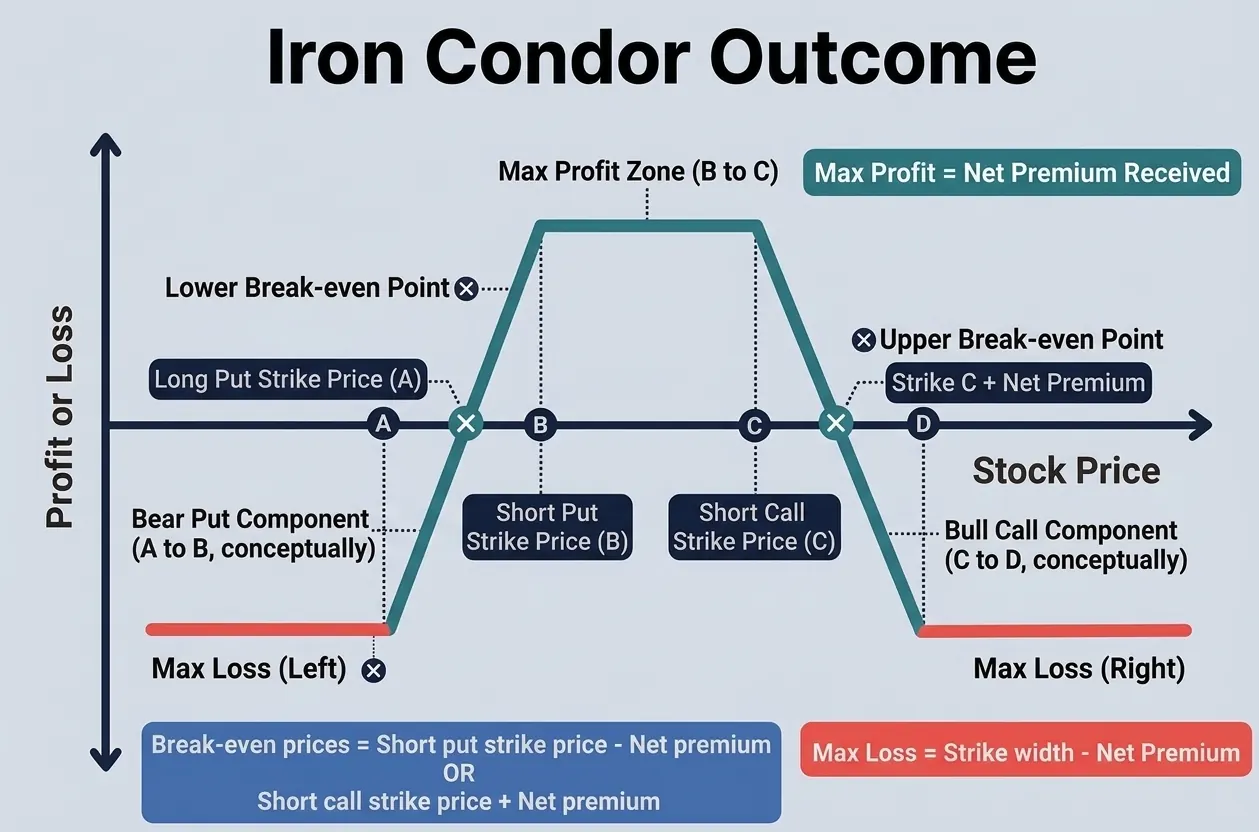
How to read the diagram
- A → B (left slope): long put wing and short put — the bear-put side of the condor
- B → C (flat top): max profit zone between the short put and short call
- C → D (right slope): short call and long call — the bull-call side
- Max profit = net premium received (credit × 100 per condor)
- Max loss = strike width of one wing − net premium (whichever side is breached)
- Green X marks = lower and upper break-evens
Beginner tips
- Start by understanding each vertical alone (bull put + bear call), then combine them
- Wider short strikes = more room / usually less credit; tighter shorts = more credit / less room
- Liquidity matters: prefer underlyings with tight spreads and decent open interest
- In the Builder, use the Iron Condor template and move spot into the middle vs outside a wing
How to practice in the Builder
- Click a Load button above (or pick the template in the Builder dropdown).
- Edit strikes and premiums to match a real chain.
- Drag Days Remaining — dotted line moves toward the solid expiry line (theta).
- Read Net Debit/Credit, max profit/loss, and Greeks under the chart.
When spreads fail beginners
IV & debit spreads
Buying a debit spread when IV is very high can still hurt if IV falls (both legs can cheapen). Credit spreads can look attractive in high IV but need room for error.
Earnings
A defined-risk spread can still lose the full max loss overnight if the underlying gaps through your short strike. Size for the full max loss, not the credit alone.
Liquidity
Four-leg structures (iron condor) multiply bid–ask friction. Prefer liquid underlyings while learning.